Introduction
The purpose of an exhibition stall is to have a brief existence.
But the materials, resources, energy, and waste involved in creating it can have a much longer life.
For decades, exhibition design has largely followed a familiar cycle: build, display, dismantle, discard, repeat. A brand arrives at an exhibition with a visually impressive space, creates an experience for a few days, and then much of that carefully constructed environment disappears.
However, producing something spectacular merely to discard it cannot be the foundation of exhibition design in the future. The next generation of exhibit booths must make an impact without producing needless trash.
This is more than just a material issue. It’s a design issue.
Designing Beyond the Exhibition Day
Designing sustainable exhibits starts far earlier than building.
Rather than asking, How should this stall look? designers should ask – After the exhibition, what should happen to this stall?
The entire design process can be altered by that one query.
The logic of a building made for a single exhibition differs greatly from that of a structure made to move between locations and accommodate various booth sizes.
The same design language can develop rather than vanish after a single event thanks to modular systems, reusable structural components, interchangeable graphics, flexible furniture, and removable pieces.
From Build-and-Break to Build-and-Adapt
Dismantling is frequently viewed as the last step in traditional exhibition design.
It is viewed as the start of the next phase in sustainable design.
Imagine a stall where the wall panels from one exhibition are repurposed as walls for a conference room. Retail fixtures are made from display units. A corporate office is furnished. Replacing graphics doesn’t require rewriting the complete structure.
All of a sudden, the exhibition stall is no longer a transient item. It turns into an assemblage of parts intended to shift, alter, and adapt. The notion that reusing a design entails exactly replicating it is also contested by this method.
Repetition is not necessary for reuse.
Designing for Disassembly
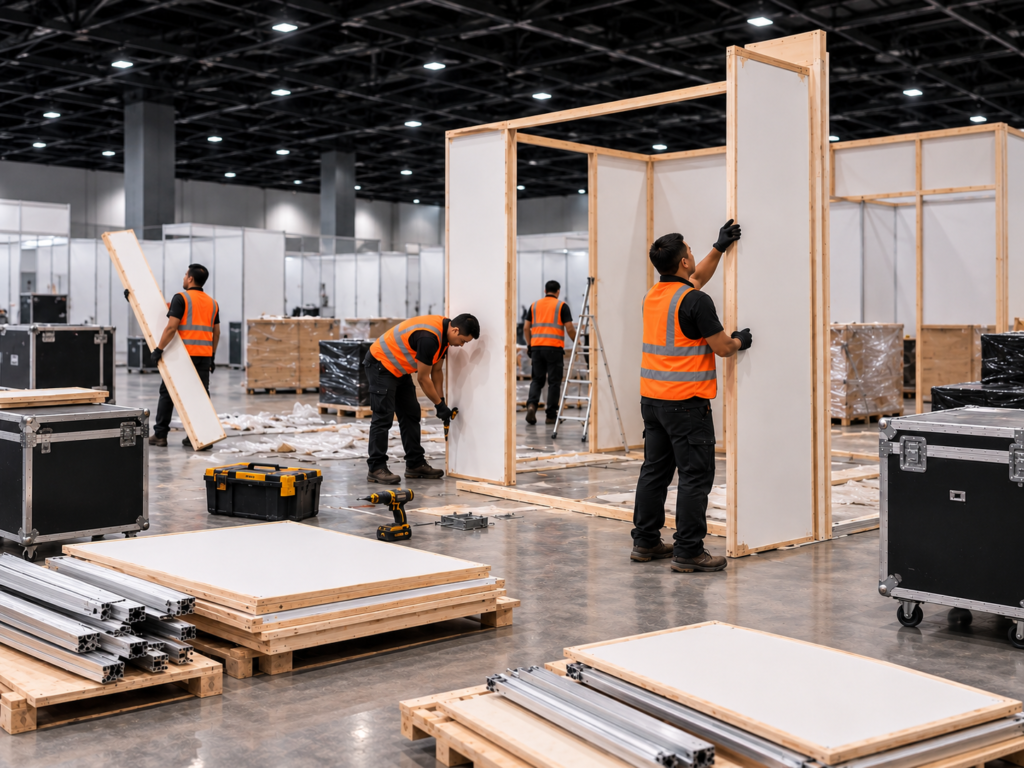
One of the most important ideas shaping sustainable exhibition design is design for disassembly. A structure should not only be easy to build. It should be easy to take apart.
This means thinking carefully about how components are joined, labelled, transported, stored, repaired, and reused. What happens to a structure after an exhibition may be limited by permanent adhesives, superfluous composite materials, and construction techniques that make separation challenging.
Future reuse is significantly more feasible when components are designed to be disassembled cleanly.
Less Material, More Meaning
Sustainability is sometimes misinterpreted as substituting supposedly “green” materials for conventional ones.
The first question should be:
Do we need this material at all?
Reducing unnecessary construction can often have a greater impact than simply changing the material.
A well-thought-out structural component that conveys the same idea may produce less waste than a big ornamental wall with no practical use. Therefore, having the booth appear “eco-friendly” is not the goal of good sustainable design.
It’s about designing better while utilizing less.
The Digital Layer Can Reduce the Physical Layer
Technology can also change the way exhibition spaces are designed. Instead of printing large quantities of temporary information, brands can use digital content that can be updated across multiple events
Certain forms of face-to-face communication can be replaced with interactive displays. Printed collateral can be decreased with digital product catalogs. Without needing a new physical installation, content may adapt to the audience, venue, or occasion.
But digital technology should not simply become another layer of excess.Screens, electronics, and interactive hardware also have environmental costs. The goal should be to use technology strategically where it genuinely extends the life and flexibility of the experience
Sustainability Should Not Look Like a Compromise
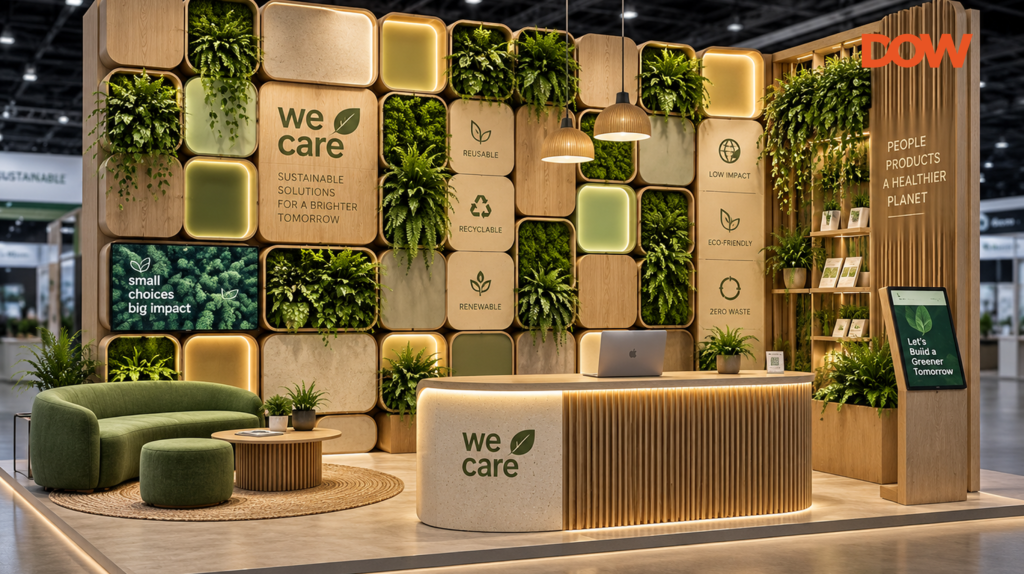
One of the biggest opportunities for sustainable exhibition design is changing the perception that sustainability means sacrificing aesthetics.
It doesn’t.
A sustainable stand can be daring, high-end, sophisticated, immersive, and incredibly engaging. In actuality, constraints can promote improved design.
It forces us to consider proportion, structure, lighting, movement, content, and spatial experience more creatively when they have fewer elements at their disposal.
Creating for Several Lives
The most significant change may be conceptual. An exhibition stall should be viewed as a long-term asset that is momentarily positioned within an exhibition, rather than as a transient construction.
A trade fair can be its first existence.
Another city might be its second.
A retail setting might be its third.
Its fourth might be installed in a workplace.
Eventually, its parts might be fixed, recycled, repurposed, or reclaimed in an ethical manner.
The Future Is Not Less Design. It Is Better Design.
Sustainability does not ask exhibition designers to create less impact. It asks them to create more meaningful impact with fewer resources.
The future exhibition stall will not necessarily be the one with the biggest structure, the most elaborate construction, or the greatest amount of material.
It may be the one that can evolve.
The one that can travel.
The one that can be dismantled.
The one that can be repaired.
The one that can be reused.
The one that remains valuable long after the exhibition closes.
Creating experiences that create a lasting impression without leaving a permanent
imprint is the true opportunity for sustainable experiential design.