
Introduction
A finished exhibition stall is the least interesting part of building one. The real work the part clients never see happens in a warehouse, a BOQ sheet, and a hundred messages to vendors trying to get everyone on the same page.
Behind every successful exhibition stand is one person (or a tight core team) quietly holding together design, procurement, fabrication, logistics, and a dozen vendors all racing against a fixed, non-negotiable deadline.
Here’s what that job actually looks like, stage by stage.
It All Starts with Understanding the Project
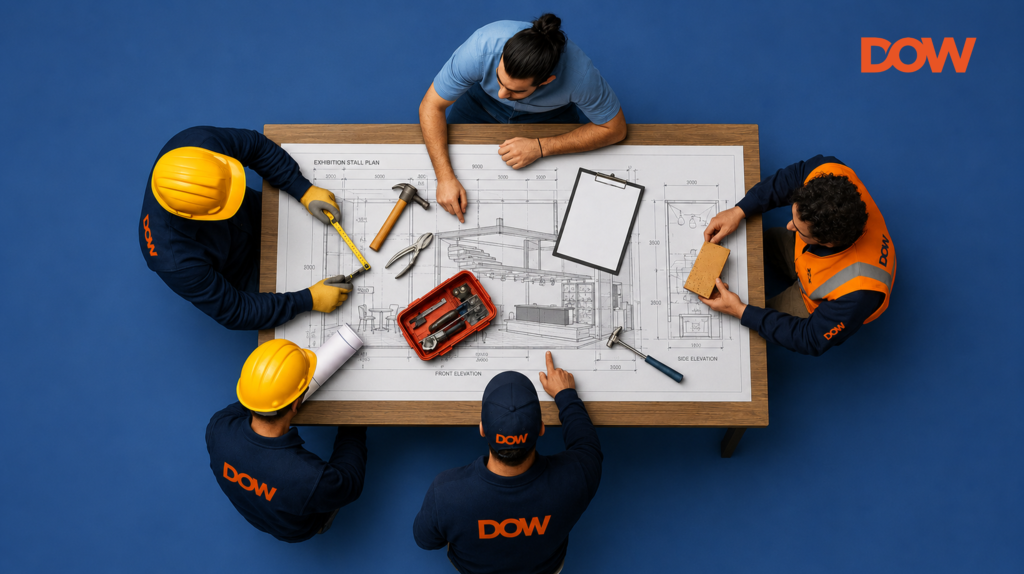
Before a single panel is fabricated, the production team studies the approved design in detail.
They review:
- Stall layout and dimensions
- Materials and finishes
- Electrical requirements
- Graphics
- Furniture
- AV equipment
- Client expectations
- Exhibition guidelines
Every detail is examined because even a small oversight can affect the final execution.
Converting a Design into a Plan: The BOQ
The production manager sits down with the authorized 3D design and breaks it down into a Bill of Quantities before a single panel is made. Each plywood sheet, vinyl meter, light fitting, screw, and other item is costed and quantified.
For the duration of the endeavor, this paper serves as the only source of truth. If you make a mistake with the BOQ, you risk blowing the budget or running out of material mid-build. When it’s done correctly, the site team, warehouse, and vendors all rely on the same precise figures.
Bringing Vendors Into Sync
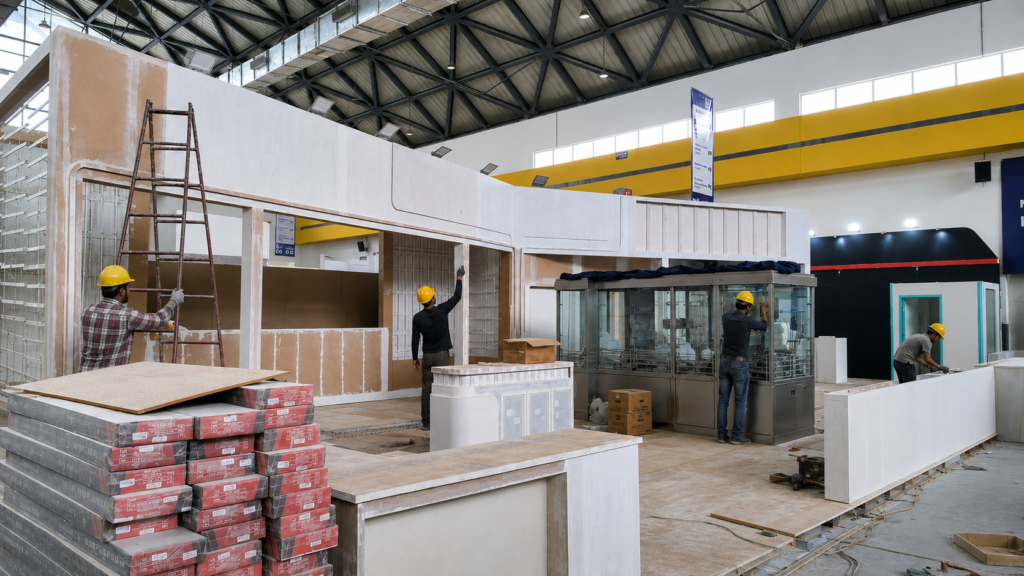
An exhibition stall isn’t built by just one team. It involves several vendors, including fabricators, printers, electricians, flooring contractors, and many others, all working together to bring the design to life.
Behind every exhibition is a production manager coordinating different vendors, following up on quotations, planning schedules, and making sure every task is completed on time. Their job is to keep everything running smoothly so the entire project stays on schedule.
Knowing the Venue Before You Arrive
Before installation begins, the production team conducts a site recce to understand the venue and identify any logistical or technical requirements. This includes checking entry and exit points, loading bay access, power supply locations, ceiling height, floor load capacity, and venue regulations. Gathering these details in advance helps the team plan the installation efficiently and minimise unexpected challenges on-site.
Getting Everything There, Intact, On Time
Once the stall is built and checked, it has to travel sometimes across the city, states without damage and without missing its slot. Every component is carefully packed, labelled, and loaded in the correct sequence so unloading and assembly at the venue happen smoothly.
The production team coordinates transport schedules, vehicle movement, entry permits, and delivery timelines while keeping track of every item. Even a delayed truck or a missing panel can disrupt the entire installation, which is why logistics is planned with the same level of precision as the stall itself.
The Build-Up: Turning Components into a Stall
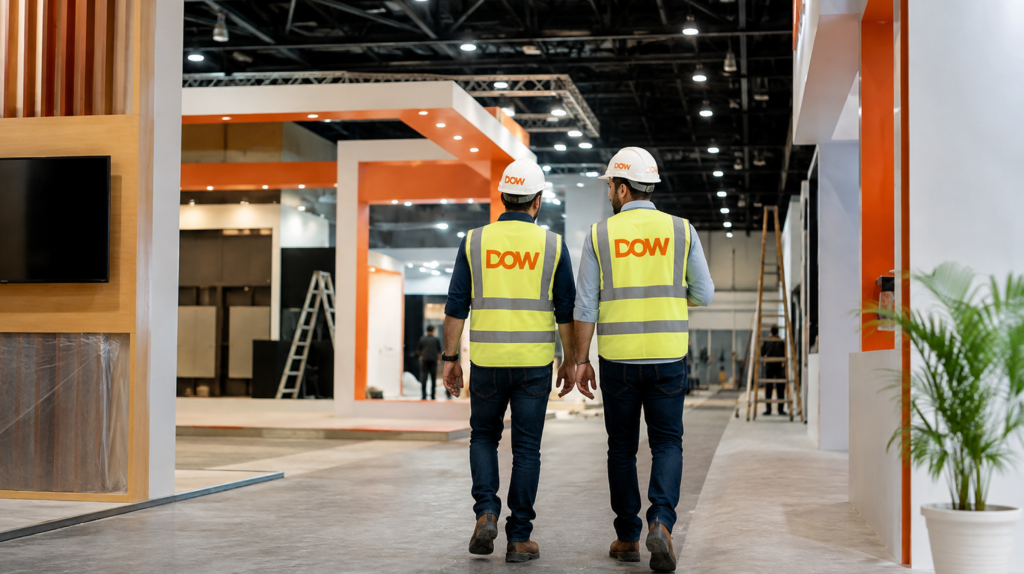
The installation begins as soon as everything arrives on site. Every team works in a planned sequence to avoid delays and ensure the stall comes together efficiently. The structure is assembled first, followed by electrical work, graphics, flooring, lighting, furniture, and AV equipment.
Every team works in a planned sequence to avoid delays and ensure the stall comes together efficiently. The structure is assembled first, followed by electrical work, graphics, flooring, lighting, furniture, and AV equipment.
Final Checks Before Opening
The production team does a thorough quality check prior to the exhibition doors opening. Every light, electrical connection, graphic panel, piece of furniture, and branding element is examined in relation to the authorized design; for example, is the fabric that was quoted, is the branding in line with the artwork file, and do all of the lights truly turn on? Any last-minute changes are finished before the client shows up rather than being marked for later.
Conclusion
The stand is fully operational and appears flawless by the time guests begin to enter. Understanding the client’s requirements, preparing the BOQ, coordinating vendors, conducting site recces, managing logistics, overseeing the build-up, and carrying out final checks all work towards one goal: delivering a stall that’s ready when the exhibition doors open.